
Orleans County Criminal Court Cases
Orleans County Court is the county's felony trial court. New York County Courts outside New York City can conduct felony trials, while County, Town, and Village courts share authority over misdemeanors and minor offenses. That split matters at the first step. A case that began with an arraignment in a local Justice Court may later move to County Court after a grand jury returns an indictment. A misdemeanor may never move at all. The Orleans Public Defender reports practice in County Court and ten local Justice Courts, which confirms that there is no single local clerk for every Orleans County criminal court case.
The Orleans County Court clerk is at 1 South Main Street, Suite 3, Albion, NY 14411. The court lists weekday hours from 9:00 a.m. to 5:00 p.m. and phone 585-283-6657. Ask whether the matter is a County Court file or began in a named Town or Village Justice Court. A defendant name helps, but an indictment or docket number is a much stronger key when it is known.
Orleans Misdemeanors in Justice Courts
A common search mistake is to assume that the county seat holds every Orleans County criminal case record. Local Justice Courts conduct arraignments and hear many misdemeanors, violations, and preliminary felony proceedings. Their own clerks keep those dockets. If a charge did not advance to an indictment, the full case may remain with the Town or Village court where it started. The official New York Courts directory is the sound way to identify the current clerk rather than relying on an old address or an unofficial listing.
Start with the paperwork tied to the event. A ticket, appearance notice, bail document, or prior court notice may name the court and docket. If that is unavailable, call Orleans County Court and ask where the case originated. Once the court is known, request the docket, filed accusatory instrument, disposition, or certificate directly from that clerk. This route is especially important for a bench warrant, since the issuing court holds the case context while a general name search is not a real-time warrant check.
Note: County Court and a local Justice Court can hold different stages of the same felony matter, so identify both before assuming a file is missing.
Searching Orleans County Case Records
Use the court of origin for a known case and the New York Statewide Criminal History Record Search, or CHRS, for a broader public court-history search. CHRS is run by the Office of Court Administration. It uses exact full name and date of birth, costs $95 for each name and birth-date combination, and returns a non-certified report based on electronic court submissions. Direct Access online and a mail request are available. Mail the form, a self-addressed stamped envelope, and a check or money order payable to NYS Office of Court Administration to CHRS Unit, 25 Beaver Street, Room 940, New York, NY 10004. Cash is not accepted, and a returned check brings a $20 charge. There is no walk-in CHRS service at that address.
- Identify the court of arraignment or filing from existing papers. For a known Orleans County case, call that clerk first.
- For a statewide check, submit the subject's exact full name and exact date of birth through CHRS Direct Access or the mail form.
- Add an alias or alternate date of birth only when needed. OCA charges each added combination as a separate search.
- Read the returned case and disposition data, then note any court name and docket or indictment number shown.
- Contact the original clerk for the docket, copies, or a certificate of disposition. Confirm current copy and certification fees with that court.
| CHRS field | Type | Required | Search note |
|---|---|---|---|
| Requestor name | Text | Yes | Names the person or company submitting the request |
| Address and phone | Text | Yes | Provides requestor contact and return details |
| Text | Conditional | Required when the result will be emailed | |
| Subject full name | Text | Yes | Strict exact match; each alias is charged separately |
| Subject date of birth | Date | Yes | Strict exact match; each alternate date is separate |
| Delivery | Choice | Yes | Mail requires a self-addressed stamped envelope |
The official CHRS overview shows how statewide public court data is requested. Its source page explains the service and its limits.
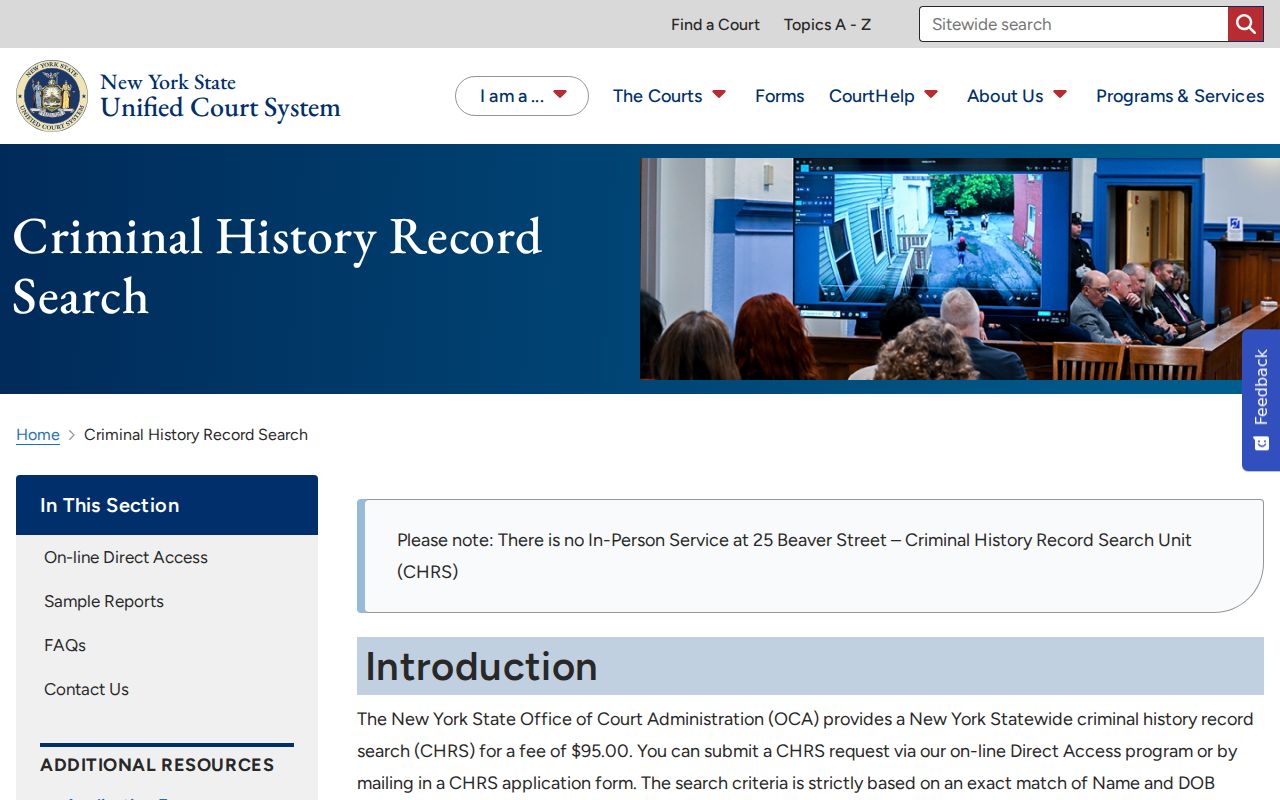
The screen is a gateway to court-history data, not to scanned Orleans County pleadings or a certified court outcome.
Missing Orleans County CHRS Cases
A blank CHRS return does not prove that no Orleans County criminal court case exists. Exact spelling and date of birth control the match. Town and Village court reporting is limited, sealed matters are excluded, and electronic transmissions may lack key data. OCA also omits a case with no final disposition after five years of inactivity unless an open arrest warrant remains. Those design rules can make a known local matter absent from the statewide result.
Call the original clerk when a case should be present. Give the name, approximate filing or arraignment date, court, and docket or indictment number if available. For one's own fingerprint-linked state record, DCJS Personal Record Review is a separate subject-only channel. An unsuppressed review can include sealed information available to the subject and can support a challenge when agency-reported data is incomplete. Neither DCJS nor county FOIL replaces a court clerk's authority over the judiciary file.
The CHRS Direct Access sign-in is shown on the official online service.
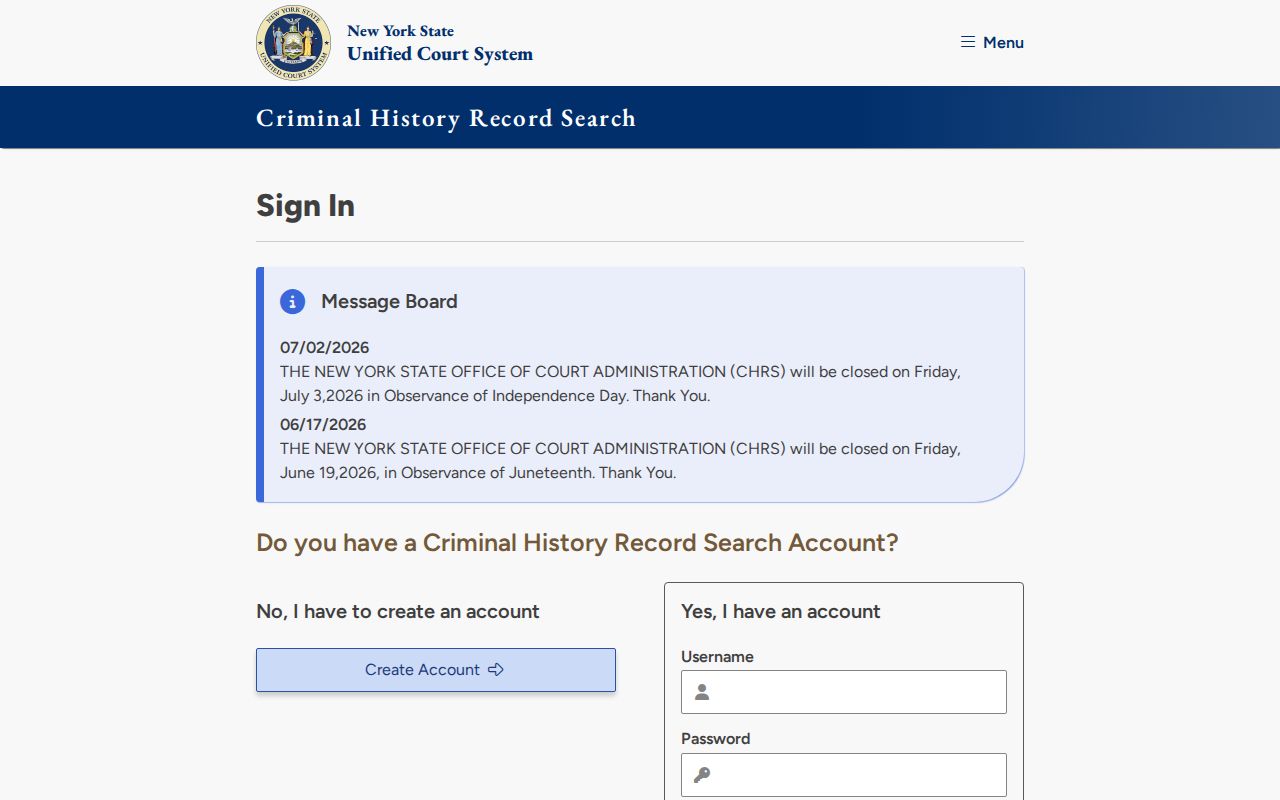
Its account interface supports statewide searching, while Orleans County clerks remain the source for filed papers and certified dispositions.
Inside an Orleans County Case File
The file traces what prosecutors charged and what the court did. It may contain the complaint, information, or indictment; appearances and motion entries; court orders; a plea or trial outcome; sentence; and financial entries such as fines or restitution. The first arrest allegation may differ from the filed count, and the filed count may differ again from the final disposition. Reading the sequence is more reliable than treating any one charge line as the whole Orleans County criminal court case.
| Case number and court | Identifies the docket, court of origin, and the office that can certify the outcome. |
|---|---|
| Charging document | Shows the complaint, information, or indictment and the statutes formally filed. |
| Docket entries | Chronicle appearances, motions, orders, adjournments, and other court activity. |
| Hearing dates | Record scheduled and completed proceedings, subject to later changes. |
| Disposition and judgment | Show dismissal, acquittal, guilty plea, verdict, or another recorded outcome. |
| Sentence and finance | May show custody, probation, conditional discharge, fines, restitution, and payment entries. |
A certificate of disposition is the court-issued proof of the outcome. CHRS expressly says its report is not certified. Request the certificate from the court that decided the case and verify that court's current fee and identification rules before sending payment or making a trip.
Orleans County Criminal Case Archives
The Orleans County Clerk at 3 South Main Street, Suite 1, Albion, keeps active and closed Supreme Court civil and criminal files plus older court series. Official judicial history identifies General Sessions criminal files from 1825 through 1847, County Court records beginning in 1847, Supreme Court material from 1851, and Circuit and Oyer and Terminer records. That depth makes the clerk useful for family history and older legal research, but it does not turn the office into the custodian of every modern Justice Court file.
Call 585-589-5334 before seeking an archived Orleans County criminal case. Give the approximate year, full name, court, and any file number. Some records may require retrieval from storage. The research did not verify digitization, a set turnaround, or a fixed criminal-copy fee, so confirm those details with the clerk. Summer 2026 counter hours are posted as 8:00 a.m. to 4:00 p.m. on weekdays from May 26 through September 4, one hour earlier than the court's listed closing time.
How a Criminal Case Moves
An Orleans County criminal court case may start with a police complaint and local arraignment. The prosecutor then decides what to pursue. A felony that proceeds can move through grand-jury review, indictment, and a new County Court arraignment. Discovery and motions follow. The case can end by dismissal, plea, or trial, after which the court enters the disposition and, when there is a conviction, the sentence. An appeal may create another record in a higher court.
Case flow: Charges Filed › Arraignment › Pretrial › Plea or Trial › Disposition › Sentencing
Each stage can change what a name search shows. A dismissal and an acquittal are not convictions. A guilty plea or verdict precedes sentencing. Grand-jury deliberations and minutes are secret even though a filed indictment and public docket will ordinarily become court records. The court's final disposition should control how the Orleans County case outcome is described.
Orleans County Specialty Court Contacts
The official Orleans court page lists two local coordinator channels that may appear in case activity. Treatment Court Coordinator James Messe can be reached at 716-544-4215. IDV Court Coordinator Amy Klein can be reached at 585-283-6638. IDV refers to an integrated domestic violence court. These contacts are useful when a known Orleans County criminal case is assigned to one of those parts, but the available research does not support assumptions about eligibility or enrollment.
Use the coordinator for program-related routing and the clerk for the record itself. A coordinator does not replace a request for the docket, filed order, or certificate of disposition. Likewise, the Orleans County District Attorney prosecutes criminal matters, but filed public case records remain with the relevant court clerk. Investigative and grand-jury material may stay restricted even when the public docket confirms that a prosecution exists.
Reading Orleans County Case Outcomes
Disposition terms carry distinct meanings. A dismissal ends a charge without conviction. An acquittal is a not-guilty trial verdict. A conviction follows a guilty plea or verdict, and the sentence records the court-ordered result. An adjournment in contemplation of dismissal, often shortened to ACD, can end in dismissal when its conditions are met. A conditional discharge imposes conditions without probation supervision. These distinctions explain why the booking charge should never be used as shorthand for the final Orleans County court result.
- Accusatory instrument
- The complaint, information, simplified information, or indictment that formally states a charge.
- Disposition
- The recorded outcome of a charge or case.
- Indictment
- A grand-jury accusation that brings felony charges into superior court.
- Recognizance
- Release on a promise to return without money bail.
- Bench warrant
- A judicial warrant often issued after a person fails to appear or follow a court direction.
When a label is unclear, ask the issuing clerk for the docket entry and certificate rather than guessing from an abbreviation. The Orleans County criminal court case record itself remains the best source for the charge-by-charge outcome.
Case Record Access & Restrictions
New York court access is shaped by both open-record principles and specific confidentiality rules. Judiciary Law §255 directs clerks to make diligent file searches and provide lawful certified transcripts or certificates where available. Yet youthful-offender matters, sealed cases, protected victim and minor information, Social Security numbers, account identifiers, and some grand-jury or investigative material are not open to ordinary public review. Administrative FOIL applies to agency records but is not a way around judicial access rules or a sealing order.
Orleans Supreme and County Court does not accept filings through EDDS, the court system's electronic document delivery service. That is a filing limit, not a statement that no public record exists. Call the chief clerk instead of assuming papers can be sent through EDDS. For an in-person visit, elevators serve all public courthouse floors, nearby spaces support accessible parking, and the street-level accessible entrance uses a call button. Accommodation requests should be made several days ahead through the Eighth Judicial District.
The Clean Slate statute adds another reason a public result can change as eligible convictions are sealed under the new process.
Sealing restricts ordinary access but does not destroy every government record or erase access granted to authorized parties.